|
|
Last Modified on Jun 15, 2026
It’s not illegal to be a jerk.
It’s not polite. It’s not productive. It might get you yelled at, ignored, or escorted out of a Waffle House. But in the United States, being rude to a government official – including a federal law enforcement officer – is not a crime. It never has been. And no press conference, congressional hearing, or social media post can change that.
That apparently needs saying right now.
What DHS Said
On June 3, 2026, Homeland Security Secretary Markwayne Mullin testified before the House Committee on Homeland Security about protests outside the Delaney Hall immigration detention facility in Newark. He said he was fine with protest done “in a peaceful way, in a legal area.” Then he added this:
“I have zero tolerance. If you verbally assault our officers, you go after our vehicles, you assault our property, you assault one of our officers, we will find you, we will arrest you.”
The Department of Homeland Security’s official account amplified the quote on X the same day.
Two of the four things on that list are federal crimes. Assaulting a federal officer is a crime. Destroying federal property is a crime. Both are serious, both are prosecuted, and both should be.
But “verbally assaulting” an officer? That is not a crime. There is no such offense in the United States Code, the Ohio Revised Code, or any municipal ordinance that would survive five minutes of constitutional scrutiny. The phrase is not a legal term. It is a political one – and when a cabinet secretary promises to “find you” and “arrest you” for it, every American should understand exactly where the legal lines actually sit.
To be fair to the Secretary: when pressed at a June 1 press conference, he defined the term narrowly. “When you’re threatening the lives of an officer, that’s verbal assault,” he said. If that is all he means, then he’s describing conduct that is already a federal crime with its own statute, its own elements, and its own case law – and the new label adds nothing. The problem is that “verbal assault” has no legal definition at all. Undefined offenses do not stay narrow. In practice, a term like that stretches to cover whatever speech the officer on the scene finds intolerable, and “zero tolerance” plus an undefined offense is how people get arrested for things the Constitution protects.
What the Law Actually Says
The federal statute covering assaults on federal officers is 18 U.S.C. § 111. Its first word matters: it criminalizes anyone who “forcibly assaults, resists, opposes, impedes, intimidates, or interferes with” a federal officer. Forcibly. Courts have consistently required actual force, the threat of force, or physical conduct. Yelling at an agent, insulting an agent, cursing at an agent, telling an agent precisely what you think of him and his agency – none of that satisfies the statute.
And the Supreme Court has not been subtle about why.
In City of Houston v. Hill, the Court struck down a city ordinance that made it unlawful to interrupt a police officer in the performance of his duties. Raymond Hill had shouted at officers to distract them from his friend. He was arrested under the ordinance. The Supreme Court held the ordinance unconstitutional and wrote one of the most quoted lines in First Amendment law:
“The freedom of individuals verbally to oppose or challenge police action without thereby risking arrest is one of the principal characteristics by which we distinguish a free nation from a police state.”
That’s not a blogger’s opinion. That’s the Supreme Court of the United States, describing exactly the conduct Secretary Mullin promised to arrest people for.
The Court went further in Hill: speech directed at police may be “provocative and challenging,” but it is protected unless it crosses into genuinely unprotected categories. And in Lewis v. City of New Orleans, the Court made clear that even profanity hurled at officers is generally protected – a principle descending from Cohen v. California, where the Court protected a man who wore a jacket reading “F*** the Draft” into a courthouse. As Justice Harlan put it, “one man’s vulgarity is another’s lyric.”
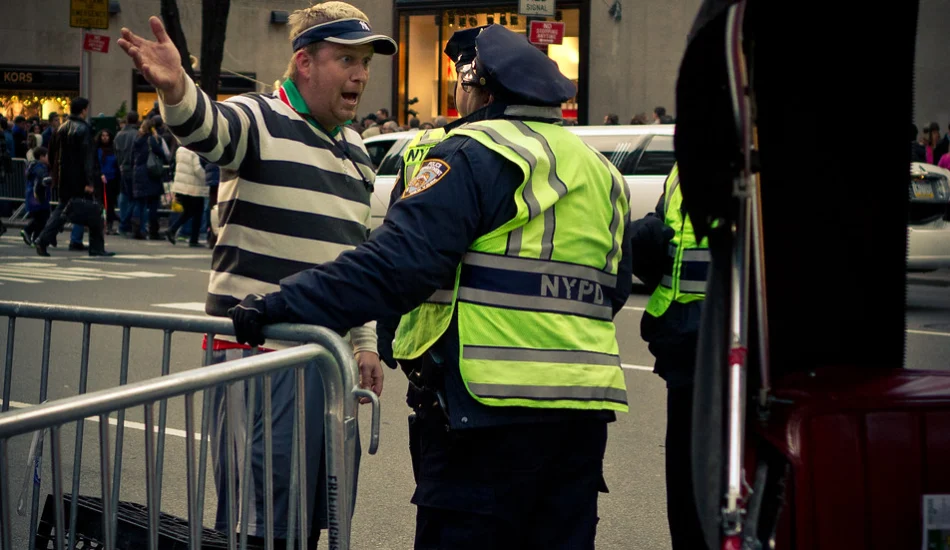
There’s one more principle from this line of cases that deserves more attention than it gets: courts expect more restraint from police, not less. A properly trained officer is expected to tolerate provocative and abusive speech that might provoke an ordinary citizen. The badge comes with thicker skin as a job requirement. Every good officer I know – and I know many, and count several as close friends – understands this. They hear worse before lunch on a Tuesday than most of us hear in a year, and they go home without arresting anyone for it. The officers who do their jobs well don’t need a made-up crime to protect them. The “verbal assault” framing isn’t protecting good cops. It’s licensing bad arrests.
Where the Line Actually Is
Now, the part that a defense attorney is obligated to tell you, because the First Amendment is not a force field.
True threats are not protected. For example, under Virginia v. Black and Counterman v. Colorado, a statement is an unprotected “true threat” when it communicates a serious intent to commit unlawful violence and the speaker was at least reckless about it being received that way. Context controls: the words, the tone, the conduct, the history between the parties.
This is not theoretical. One Delaney Hall protester, 27-year-old Nicholas Scelfo of Brooklyn, was arrested two days after allegedly pointing at an ICE officer on May 27 and shouting that he would kill the officer’s entire family – his wife, his children, all of them. He has been charged federally with influencing, impeding, and retaliating against a federal officer by threat, an offense carrying up to ten years, and was released on a $100,000 bond after his June 1 court appearance. Whatever you think of ICE, that is a chargeable threat under existing law. (The criminal complaint also notes the same officer had struck Scelfo twice with a baton during an earlier altercation – context his defense attorney will certainly explore, because context always matters in threat cases.) “Your agency is a disgrace” is protected. “I will kill your family” is not. The law has never had trouble telling these apart – and notice that prosecuting Scelfo required no new crime of “verbal assault.” The real laws already covered the real misconduct.
Physical interference is not protected. Blocking agents, grabbing them, spitting on them, damaging vehicles – all of that is conduct, not speech, and it’s chargeable under § 111 federally or under Ohio law.
And here in Ohio, when someone mouths off to an officer and ends up in handcuffs, the charges that actually appear on the citation are usually disorderly conduct, obstructing official business, or resisting arrest. Here’s what two decades in Ohio criminal courtrooms – on both sides of the aisle, since I started as a prosecutor – has taught me about those charges: when the only “conduct” is words, they are beatable. Disorderly conduct requires more than offending an officer’s ears. Obstructing requires an affirmative act that actually hampers the officer’s duties – speech alone, even hostile speech, generally doesn’t qualify. Officers sometimes charge first and let the prosecutor sort it out. That’s precisely when you call a defense lawyer.
Why This Matters Beyond One Hearing
You might be tempted to shrug this off as a politician talking tough. Don’t. When the Secretary of Homeland Security tells Congress that the department will arrest people for speech, and federal agents at protest sites act on that understanding, people get handcuffed for things the Constitution protects. Some of those charges get dismissed months later, after the arrest has already cost someone a job, a security clearance, or a custody arrangement. The arrest is the punishment, even when the case collapses.
Our firm’s mission statement says we are the last line of defense between society and an oppressive government. This is what that looks like in practice: not grand speeches, but knowing – precisely, with citations – where your rights end and the government’s power begins, and holding that line one case at a time. The freedom to verbally challenge police “is one of the principal characteristics by which we distinguish a free nation from a police state.” The Supreme Court said that in City of Houston v. Hill. Good officers already live by it. The rest is our job.
If You’ve Been Charged
If you or someone you know has been arrested or charged in Northeast Ohio for something you said to a police officer or federal agent – disorderly conduct, obstruction, resisting, or a federal charge under § 111 – the facts and the case law matter enormously, and they are frequently on your side. Call Fortress Law Group at (440) 340-1740 for a consultation.
This post is legal information, not legal advice. Every case turns on its specific facts.