|
|
Last Modified on Jun 15, 2026
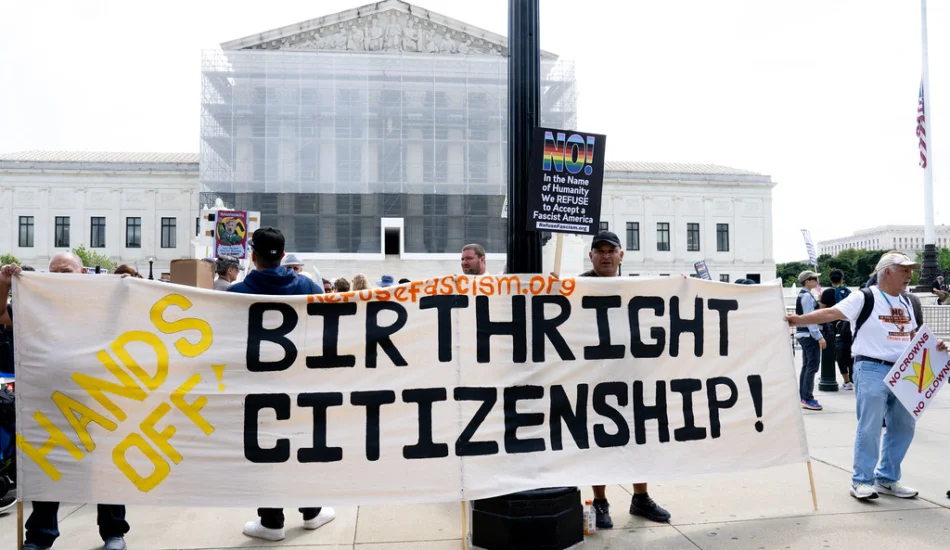
Two days ago the Supreme Court struck down the executive order that tried to end birthright citizenship. The headlines said 6-3. Read the vote a little closer and the number that should keep you up at night is 5. Five justices held that the Fourteenth Amendment itself guarantees citizenship to nearly every child born on American soil. One more – Kavanaugh – agreed the order was illegal but refused to say the Constitution required that result. He said a mere statute did the work, and that Congress could rewrite the statute.
Within hours, Senate Republicans and the Speaker of the House had their roadmap. Trump posted that Congress should start today. The story being written this week is that the fight now moves to Capitol Hill, that birthright citizenship is one act of Congress away from disappearing for the children of undocumented and temporary residents.
Here is the argument almost nobody is making clearly: that roadmap probably runs straight into a wall the majority just finished building. Kavanaugh drew a map to a door the other five justices may have already locked.
What actually happened
The case is Trump v. Barbara, decided June 30, 2026. Chief Justice Roberts wrote for the Court, joined by Barrett and the three liberal justices – Sotomayor, Kagan, and Jackson. That is your five-vote constitutional majority. Their holding is not subtle. Children born here to parents who are unlawfully or temporarily present are subject to the jurisdiction of the United States, and under the Constitution they are citizens at birth. Not by grace of a statute. By force of the Fourteenth Amendment.
Roberts got there the way birthright citizenship has always been defended: English common law, the colonial and antebellum eras, the 1868 ratification debates, and the 1898 decision in United States v. Wong Kim Ark. He rejected the government’s domicile theory – the idea that citizenship depends on where the parents make their permanent home – because, in his words, there is scant evidence the ratifiers thought they were imposing any such limit.
Then there is Kavanaugh. He concurred in the judgment and dissented in part. He agreed the order had to fall, but on statutory grounds: it violated 8 U.S.C. 1401(a), the federal law that codifies birthright citizenship in language that mirrors the amendment. And he added the sentence every immigration hardliner has been quoting since Tuesday: Congress could, consistent with the Fourteenth Amendment, amend that statute or pass new legislation creating exceptions for children born to foreign citizens unlawfully or temporarily in the country.
Thomas and Gorsuch dissented outright and would have upheld the order. Alito dissented separately, calling the majority’s conclusion a serious mistake. So on the raw question – does the Constitution compel birthright citizenship – the real count is five yes, four no.
Why the Kavanaugh roadmap probably goes nowhere
Kavanaugh’s concurrence contains a hidden assumption, and the assumption is the whole ballgame. His sentence says Congress can legislate exceptions consistent with the Fourteenth Amendment. That phrase only works if the Fourteenth Amendment permits such exceptions in the first place. Five justices just held that it does not.
Walk the logic. If birthright citizenship is a statutory gift, Congress can take it back – amend 1401(a), carve out the children it wants to exclude, done. But if birthright citizenship is a constitutional floor, a statute that tries to drop below that floor is unconstitutional the moment it passes. It does not matter how many votes it got. It gets challenged, it reaches a court, and the court applies the same Fourteenth Amendment the majority just interpreted to require the very citizenship the statute tries to deny.
A statute cannot override a constitutional holding. The only thing that overrides a constitutional holding is a constitutional amendment – two-thirds of both chambers and thirty-eight state legislatures – or the Court reversing itself. Kavanaugh’s statutory theory does not command a majority. Roberts and four others expressly rejected it. So a Congress that follows Kavanaugh’s roadmap is following one justice’s minority reasoning into litigation the other five have already told it how they will resolve.
Put bluntly: the statutory path Republicans are racing to exploit assumes a premise five justices killed on Tuesday. That is not a roadmap. It is a dead end with good signage.
So where is the real threat?
If I only told you the good news I would be doing what most of the commentary is doing this week, which is confusing a favorable outcome with a durable one. The order is dead. The doctrine is not safe. Here are the three vectors that actually matter, weakest to strongest.
Vector one: the statute (loud, likely futile)
This is the one dominating the news. Speaker Johnson says Congress will act. It will generate enormous coverage. It will also almost certainly lose, for the reason above, and it faces a second problem before it even gets to court: the votes are not there. A statute stripping citizenship from a quarter-million babies a year runs into a Senate filibuster, a midterm calendar, and polling that shows majority support for birthright citizenship among independents and even a plurality of Republicans. Loud, yes. Lethal to birthright citizenship, no.
Vector two: the domicile theory returns with a different Court (patient, plausible)
This is the one that should worry you more, precisely because it is quiet. The four dissenters did not lose on a technicality. Thomas built a lengthy argument that the Citizenship Clause requires parental domicile, not mere birth on the soil. That theory, mocked a decade ago, just got four votes. Chief Justice Fuller’s dissent in Wong Kim Ark – the one that resisted extending the common-law rule to children born during a temporary or accidental sojourn – is no longer a historical footnote. It is a live blueprint with a bloc behind it.
The swing vote that saved birthright citizenship was not a liberal. It was Barrett. Subtract one seat from the majority side, add one to the dissent, and the domicile theory has five votes and a vehicle. Eastman, the architect of the losing argument, already said the quiet part: the question could return on a petition for rehearing or in a future case. A single confirmation fight is the whole distance between a 5-4 win and a 5-4 loss.
Vector three: burden without denial (already here)
The sleeper threat is not a frontal attack on citizenship at all. It is friction. Even with the constitutional question settled, an administration can make birthright citizenship expensive and slow to prove – documentation demands at birth, passport and benefit scrutiny, investigations into so-called birth tourism, restrictions targeting pregnant travelers. White House aides were reportedly discussing exactly these measures within hours of the loss. None of them denies citizenship on paper. All of them raise the cost of holding it, and they fall hardest on the families least able to litigate. This vector does not need Congress or a new Justice. It needs only administrative discretion, and it is available now.
The bottom line
The reassuring version of this week is that the Supreme Court affirmed a bedrock principle 6-3 and the matter is closed. That version is wrong on the vote and wrong on the risk. The constitutional floor rests on five justices and one retirement. The Kavanaugh statutory roadmap that Congress is chasing is likely a cul-de-sac, which means the noise on Capitol Hill is the least of it. The durable threats are the ones getting the least attention: a future Court that adopts the domicile theory the dissenters just legitimized, and an executive branch that burdens the right without formally denying it.
Birthright citizenship won on Tuesday. It did not win permanently. The difference between those two sentences is one Supreme Court seat, and everyone counting to six should be counting to five.